Agricultural Machinery Investment in Guinea: Modern Farming – Guinea’s agricultural sector is entering a period of modernization as commercial farming, food security, agro-processing, and private investment receive increasing attention. For investors, this transformation creates opportunities beyond crop cultivation itself. Agricultural Machinery Investment in Guinea can support the equipment, services, and infrastructure needed to make commercial farming more productive and scalable.
The opportunity is particularly relevant as Guinea works to strengthen agricultural value chains. In April 2026, the Government of Guinea and the World Bank launched the AgriConnect Compact, which identifies agricultural transformation, private-sector participation, productivity, food security, and job creation as important priorities. Rice, poultry, maize, soybeans, fonio, and mangoes are among the value chains receiving attention.
This creates demand for machinery that can improve land preparation, planting, irrigation, harvesting, transportation, storage, and post-harvest operations.
For investors, the opportunity is not limited to purchasing tractors. It can include machinery distribution, equipment rental, maintenance services, spare-parts supply, irrigation equipment, harvesting technology, and integrated mechanization services.
Why Agricultural Machinery Investment in Guinea Matters
Agriculture remains an important part of Guinea’s economy and rural employment. A January 2026 World Bank report noted that agriculture employs 52% of Guinea’s workforce while formal farming remains limited, highlighting opportunities to improve productivity, commercialization, and processing investment.
One of the challenges facing commercial agriculture is the ability to complete farm operations at the right time and at an economically viable scale.
Manual farming can make land preparation, planting, harvesting, and transportation slower and more dependent on seasonal labor availability. Mechanization can help commercial operators manage larger production areas while improving the timeliness and consistency of agricultural operations.
The Food and Agriculture Organization (FAO) explains that sustainable mechanization can reduce hard labor, improve productivity and timeliness, increase resource efficiency, improve market access, and contribute to resilience.
This makes agricultural machinery an important component of Guinea’s transition from predominantly manual production toward more commercially organized farming systems.
Key Opportunities for Agricultural Machinery Investment in Guinea
1. Tractor and Farm Equipment Distribution
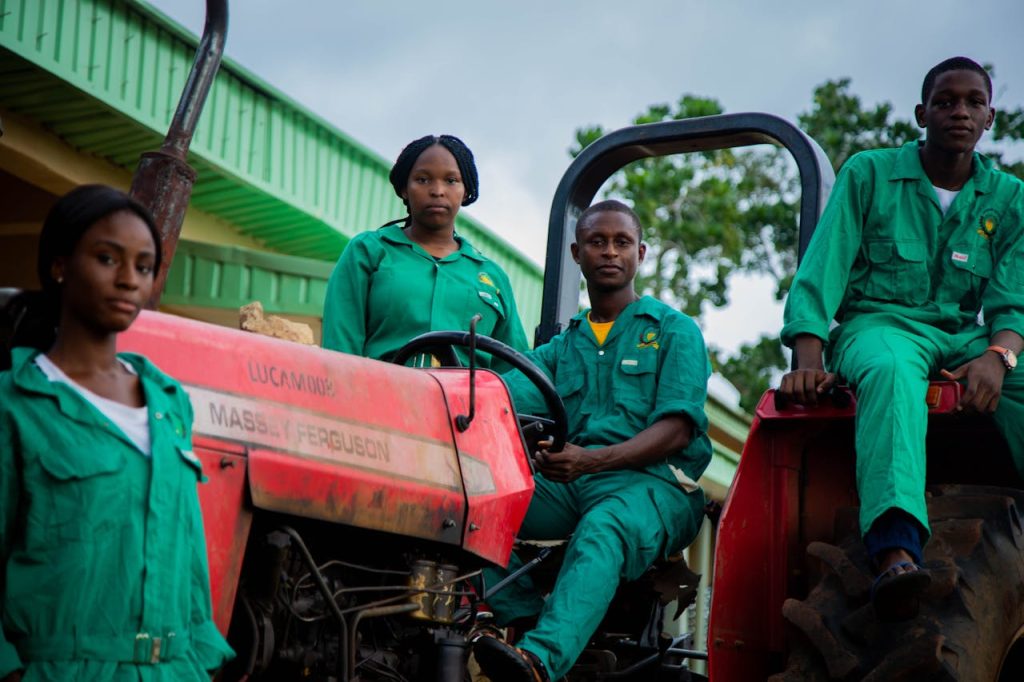
Tractors remain one of the most important categories of agricultural machinery for commercial farming.
Investment opportunities can involve importing, distributing, leasing, or selling tractors and compatible implements such as:
- Ploughs
- Harrows
- Disc cultivators
- Seeders
- Planters
- Trailers
- Sprayers
- Fertilizer spreaders
Rather than focusing only on high-horsepower equipment, investors can develop product portfolios based on the needs of Guinean farms.
FAO notes that mechanization solutions need to be appropriate for local conditions because large machinery does not necessarily fit every farm, terrain, or production system.
For Guinea, this means machinery businesses can potentially serve both large commercial farms and smaller producers through equipment rental and shared-use models.
2. Agricultural Machinery Rental Services
Purchasing machinery outright can require significant capital, particularly for farmers who only need equipment during specific stages of the production cycle.
This creates an opportunity for farm equipment rental in Guinea.
An investor could establish a mechanization service company that owns tractors and implements and rents them to farms according to their operational needs.
Potential services include:
- Land clearing and preparation
- Ploughing and harrowing
- Planting
- Fertilizer application
- Crop spraying
- Harvesting
- Transport
- Post-harvest handling
FAO specifically identifies mechanization hire services as a viable business model and highlights the importance of developing enterprises that provide mechanized services to farmers.
This model can make machinery more accessible while creating a recurring revenue stream for equipment owners.
3. Rice and Cereal Mechanization
Rice and other cereals represent an important area for mechanization investment.
Guinea’s AgriConnect Compact identifies rice and poultry as priority value chains for strengthening food security and reducing import dependence, while maize and soybeans are also identified as strategic agricultural inputs.
Machinery investment can support multiple stages of these value chains.
For rice farming, for example, opportunities may include:
- Tractor-based land preparation
- Irrigation pumps
- Rice transplanters
- Harvesters
- Threshers
- Grain dryers
- Milling equipment
- Storage and handling systems
FAO’s investment presentation for Guinea has also identified improved access to mechanization as part of interventions designed to increase productivity in rice and maize value chains.
This creates an opportunity to combine machinery investment with agricultural production and processing rather than treating equipment as a standalone business.
4. Irrigation and Water Management Equipment
Machinery investment in Guinea can also extend beyond tractors.
Irrigation equipment can help commercial farms manage water more efficiently and reduce dependence on rainfall patterns.
Potential investments include:
- Water pumps
- Solar-powered irrigation systems
- Drip irrigation
- Sprinkler systems
- Water storage equipment
- Irrigation controllers
- Filtration systems
For investors developing commercial farms, combining irrigation with mechanized land preparation and harvesting can create a more integrated production system.
This is especially relevant for farms seeking more predictable production cycles and better utilization of agricultural land.
Agricultural Machinery for Agro-Processing
Modernization does not stop when crops leave the field.
Post-harvest equipment can determine how much agricultural value is retained before products reach processors, wholesalers, or consumers.
Machinery investment can therefore extend into:
- Rice milling
- Grain cleaning
- Grain drying
- Cassava processing
- Fruit processing
- Oilseed processing
- Feed production
- Packaging
- Cold-chain handling
FAO emphasizes that mechanization can contribute to value addition and the development of agricultural value chains, including processing and post-harvest operations.
This creates opportunities for investors who want to combine Agricultural Machinery Investment in Guinea with agro-processing.
For example, an investor could develop a business that provides farm machinery during production while also operating processing equipment after harvest. This can create multiple revenue points within the same agricultural value chain.
Machinery Maintenance and Spare Parts: An Often-Overlooked Opportunity
Selling machinery is only one part of the agricultural equipment market.
Commercial farms need reliable maintenance, replacement parts, trained operators, and technical support. Without these services, expensive machinery can remain unused when a component fails during a critical farming period.
FAO describes the machinery supply chain as involving manufacturers, importers, dealers, hire-service providers, repairers, and farmers.
This means investors can consider businesses focused on:
Equipment Repair Centers
A specialized repair center can provide diagnostics, engine maintenance, hydraulic repairs, welding, and preventive servicing.
Spare Parts Distribution
A reliable spare-parts network can support tractors, harvesters, pumps, irrigation systems, and other agricultural equipment.
Operator Training
Training machinery operators can improve equipment utilization and reduce avoidable damage caused by improper operation.
Mobile Maintenance Services
Mobile technicians can travel to farms, reducing downtime and making maintenance more accessible outside major urban centers.
These supporting services can become an important part of the agricultural mechanization ecosystem.
How to Structure an Agricultural Machinery Investment in Guinea
Investors should evaluate the business model before purchasing equipment.
A practical investment strategy can begin with identifying the crops, farm sizes, production areas, and machinery gaps within a target market.
The process can include:
Step 1: Identify the Agricultural Value Chain
Determine whether the target market is rice, maize, cassava, fruit, livestock feed, or another agricultural segment.
Step 2: Assess Equipment Demand
Identify which farming operations are currently labor-intensive or causing production delays.
Step 3: Select the Right Machinery
Equipment should match soil conditions, terrain, farm size, crop requirements, fuel availability, operator skills, and maintenance capacity.
Step 4: Build the Support Network
Establish access to spare parts, technicians, operators, storage facilities, and transportation.
Step 5: Develop a Revenue Model
Investors can choose among direct equipment sales, leasing, machinery rental, contract farming services, maintenance, or integrated agricultural operations.
Step 6: Review Regulatory and Business Requirements
Foreign investors planning to establish an agricultural machinery company should assess company registration, import procedures, taxation, contracts, and sector-specific requirements before entering the market.
For an overview of establishing a business in Guinea, see the How to Start a Business in Guinea guide.
Financing and Scale: From Equipment Ownership to Mechanization Services
One of the biggest opportunities may be shifting from the traditional idea of simply owning machinery toward providing mechanization as a service.
A machinery company can potentially serve multiple farms with the same equipment fleet.
For example, a tractor could be used for land preparation across several commercial farms during the planting season rather than remaining dedicated to one farm.
This approach can improve equipment utilization and create a broader customer base.
FAO highlights the importance of business models, hire services, and private-sector participation in expanding access to mechanization.
Investors should nevertheless account for fuel, transportation, operator wages, maintenance, depreciation, spare parts, insurance, and seasonal demand when developing the financial model.
Guinea’s Agricultural Modernization Creates a Broader Investment Ecosystem
Agricultural machinery should not be viewed in isolation.
Guinea’s current agricultural development agenda is increasingly focused on commercialization, private investment, value addition, infrastructure, and job creation. The World Bank’s second phase of the Commercial Agriculture Development Project, approved in June 2026, is designed to promote commercialization, attract private investment, and expand employment in agricultural value chains.
For investors, this means machinery can become part of a wider ecosystem involving:
- Commercial farms
- Agricultural cooperatives
- Irrigation projects
- Agro-processing facilities
- Storage infrastructure
- Transportation
- Equipment rental
- Repair and maintenance
- Agricultural input distribution
Investors exploring broader opportunities can also review Agriculture and Agribusiness opportunities in Guinea and the Investment Opportunities in Guinea overview.
Challenges Investors Should Consider
Agricultural machinery investment also requires careful planning.
Equipment selection should reflect local operating conditions rather than simply importing the most advanced machinery available. FAO notes that mechanization can create environmental and economic challenges when equipment is poorly matched to local conditions.
Investors should therefore evaluate:
- Availability of spare parts
- Local technical skills
- Fuel and energy costs
- Road access to farms
- Seasonal machinery demand
- Equipment utilization rates
- Financing requirements
- Soil and terrain conditions
- Operator training
- Maintenance infrastructure
A strong after-sales network can be just as important as the machinery itself.
Frequently Asked Questions
1. What is Agricultural Machinery Investment in Guinea?
Agricultural Machinery Investment in Guinea involves investing in tractors, farm equipment, irrigation systems, harvesting machinery, processing equipment, rental services, maintenance, and related agricultural technology.
2. Is agricultural machinery rental a business opportunity in Guinea?
Yes. Machinery rental and mechanization hire services can provide farmers with access to equipment without requiring them to purchase entire machinery fleets. FAO recognizes hire services as an important business model for expanding mechanization access.
3. Which agricultural machinery can investors consider in Guinea?
Potential equipment includes tractors, ploughs, planters, harvesters, irrigation pumps, threshers, grain dryers, milling machines, trailers, sprayers, and agricultural processing equipment.
4. Why is agricultural mechanization important for commercial farming?
Mechanization can improve the timeliness and efficiency of farming operations, reduce labor requirements for certain tasks, and help commercial farms manage larger production areas. FAO identifies productivity, timeliness, resource efficiency, and market access among the potential benefits of sustainable mechanization.
5. How can investors enter Guinea’s agricultural machinery sector?
Investors can consider equipment distribution, machinery rental, leasing, maintenance, spare-parts distribution, mechanized farming services, or integrated agricultural projects. Before investing, they should conduct market, technical, financial, and regulatory due diligence.
Conclusion: Building the Future of Commercial Farming in Guinea
Agricultural Machinery Investment in Guinea represents an opportunity to participate in the modernization of the country’s commercial farming ecosystem.
The opportunity goes beyond tractors. Equipment rental, irrigation, harvesting, post-harvest processing, spare parts, maintenance, and mechanization services can all support the growth of more productive agricultural value chains.
With Guinea placing greater emphasis on agricultural commercialization, food security, private investment, and value addition, machinery can play an important role in connecting agricultural potential with commercial-scale production.
For investors, the key is to select equipment and business models that fit Guinea’s actual agricultural conditions and customer demand.
Explore Agricultural Machinery Investment Opportunities in Guinea
Looking to invest in agricultural machinery, commercial farming, agro-processing, or related services in Guinea?
Yes! Invest Guinea can help investors explore market opportunities, understand local requirements, identify potential business structures, and navigate the process of entering Guinea’s agricultural sector.
Contact Yes! Invest Guinea to discuss your agricultural machinery or agribusiness investment project and explore opportunities for building a modern commercial farming operation in Guinea.