For decades, Simandou sat in the mountains of southeastern Guinea as the world’s most tantalizing mining prospect, a deposit so large and so high-grade that the industry kept returning to it, and so logistically complex that it kept defeating everyone who tried to develop it. That era is over. Simandou is no longer a promise. It is a producing mine, a functioning railway, and an operating port and it is reshaping global iron ore markets in real time.
For investors tracking iron ore in Guinea, the story has moved past “will this ever happen?” to “what does this mean for every adjacent opportunity?” In this guide, Yes! Invest Guinea breaks down the full picture: the scale of the Simandou project, the ownership architecture behind it, what the IMF says it will do to Guinea’s economy, and where investor entry points remain open across the iron ore value chain.
Simandou: The World’s Largest Untapped High-Grade Iron Ore Deposit
Simandou is not a large iron ore deposit by African standards. It is one of the largest high-grade iron ore deposits on earth, by any standard. According to Rio Tinto’s official investor disclosures, the SimFer joint venture’s mine concession alone holds an estimated 1.5 billion tonnes of ore reserves with an average grade of 65.3% iron and low impurities supporting a mine life of 26 years. An additional 1.4 billion tonnes of mineral resources sits outside those reserves, with grades averaging 66.1% iron.
To put those grades in context: S&P Global’s analysis of Simandou notes that the deposit’s average iron content of 65.8% and low impurity profile make it directly comparable to Vale’s Northern System in the Carajás province of Brazil one of the most prized iron ore operations in the world. Ore of this quality commands premium pricing in steelmaking markets, particularly among manufacturers targeting low-carbon steel production where ore purity reduces coking coal requirements.
From Decades of Delay to Active Production in 2026
Simandou’s development history is defined by obstacles that took two decades to overcome: disputed ownership, political instability, infrastructure gaps measured in hundreds of kilometers, and capital requirements too large for any single actor to absorb. What ultimately unlocked the project was a combination of Chinese industrial appetite, structured multi-party ownership, and a Guinean government determined to make it happen.
The first commercial cargo left Guinea in December 2025 and reached China in early 2026 beginning what the IMF has described as a potentially transformative chapter for the Guinean economy. According to reporting from Mongabay, SimFer expects to produce between 5 and 10 million metric tons in 2026 alone, with a ramp-up over approximately 30 months toward a target of 60 million tonnes per year and an ultimate potential of 120 million tonnes annually at full buildout. The IMF projects that Simandou at full capacity could boost Guinea’s GDP by more than 25% by 2030.
How Simandou’s Ownership Is Structured
Understanding who controls what in Simandou matters enormously for investors thinking about adjacent opportunities, partnerships, and supply chain entry points.
SimFer: Rio Tinto and Chinalco
SimFer controls Simandou South (Blocks 3 and 4). It is a joint venture between Rio Tinto, one of the world’s most experienced large-scale iron ore operators, and Chinalco (Aluminum Corporation of China), a Chinese state-owned metals enterprise. The Government of Guinea holds a 15% equity stake in SimFer, giving the state a direct financial interest in the project’s performance. According to Rio Tinto’s investor materials, its initial share of capital expenditure for the mine and shared infrastructure is approximately $6.2 billion.
Winning Consortium Simandou (BWCS): Baowu and Winning International
The Winning Consortium Simandou controls Simandou North (Blocks 1 and 2). It is backed by Baowu Steel Group the world’s largest steelmaker by production volume and Singapore-linked Winning International Group, which has been one of Guinea’s most active bauxite exporters. The structure embeds both industrial end-use demand and Asian trading network capabilities directly into the project’s ownership, ensuring that offtake commitments are built into the joint venture rather than dependent on spot market conditions.
Compagnie du TransGuinéen (CTG): The Shared Infrastructure Spine
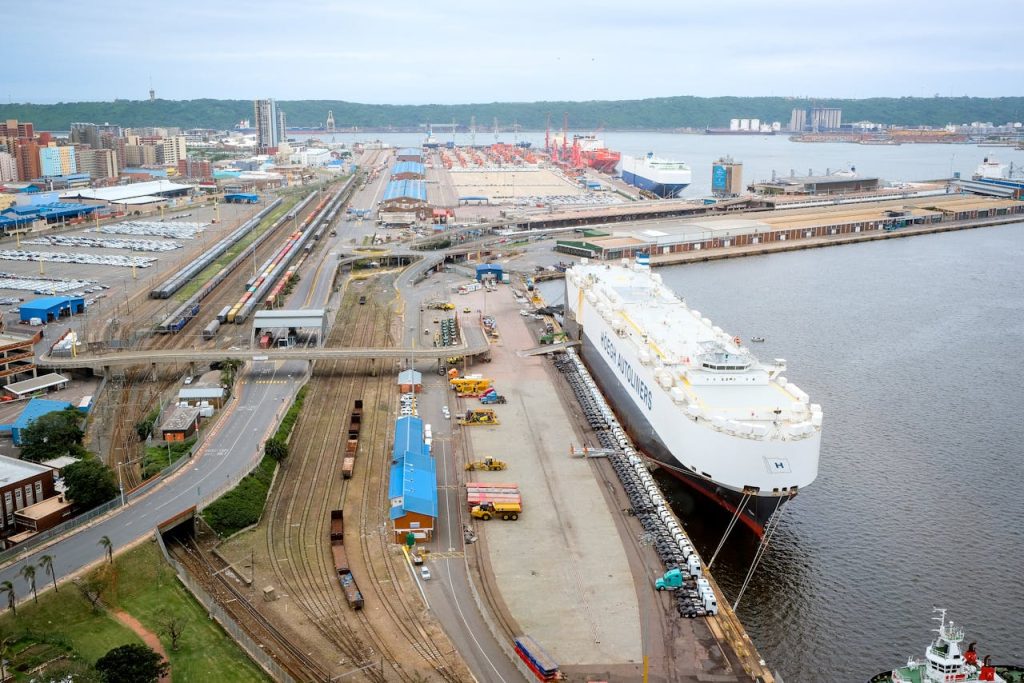
Both consortia share a common-use railway and port infrastructure under a joint venture called the Compagnie du TransGuinéen (CTG). This entity manages more than 600 kilometers of newly built multifunctional railway connecting the southeastern mining concessions to new deep-water export terminals on Guinea’s Atlantic coast at the port of Morebaya. According to GMK Center’s project overview, the commissioning of this rail and port system confirms the readiness of the entire logistics infrastructure needed to sustain large-scale production a critical milestone that took years of hard bargaining between competing consortia to settle.
The total capital commitment across mine development and shared infrastructure has been estimated at $23 billion, making Simandou one of the largest private infrastructure investments ever undertaken on the African continent.
What Simandou Means for Guinea’s Economy and Investment Landscape
The economic implications of Simandou extend well beyond royalties and export revenues. Guinea’s government has already announced plans to launch a Simandou-backed national wealth fund, intended to channel resource revenues into long-term economic development rather than short-term spending.
Beyond the macro-level impact, Simandou is reshaping Guinea’s investment landscape across multiple dimensions:
Supplier and Service Market Creation
A mine and rail corridor of Simandou’s scale creates sustained demand for construction services, engineering contractors, maintenance providers, fuel and energy suppliers, catering and camp management services, and environmental monitoring operations. These supplier and service market opportunities exist independently of whether an investor can participate at the equity level in the mine itself.
Port and Logistics Infrastructure Effects
Guinea nearly doubled its port capacity during 2025, expanding from five to nine export-ready terminals as the country prepared for Simandou’s initial production. This infrastructure expansion creates logistics investment opportunities beyond iron ore warehousing, freight forwarding, multimodal connectivity, and container handling operations that serve the broader export economy, not just Simandou’s own logistics needs.
The Mount Nimba Iron Ore Opportunity
Simandou is not the only iron ore opportunity in Guinea. The Mount Nimba iron ore deposit, located in Guinea’s Forest Region near the borders of Liberia and Côte d’Ivoire, represents a separate and substantially less developed opportunity for investors interested in earlier-stage iron ore assets. High Power Exploration has been advancing exploration work at Mount Nimba, and the infrastructure being built for Simandou may eventually reduce the logistics challenges that have historically complicated Mount Nimba’s development case.
Investment Entry Points in Guinea’s Iron Ore Sector
For most institutional investors, direct equity participation in SimFer or BWCS is not a realistic near-term entry point — these are structured joint ventures with closed ownership architecture. However, the iron ore sector in Guinea creates multiple accessible investment categories:
- Infrastructure and logistics services supporting the CTG railway corridor and Morebaya port terminal
- Supplier contracts for maintenance, energy, civil construction, and operational services at both mining consortia
- Downstream steel and value-added processing, which the Simandou 2040 roadmap explicitly identifies as a national priority alongside iron ore extraction
- Exploration and development of early-stage iron ore assets in Guinea outside the Simandou concessions, including the Mount Nimba area
How Yes! Invest Guinea Supports Iron Ore Investors
Yes! Invest Guinea connects investors with structured opportunities across Guinea’s iron ore value chain. Our support includes:
- Identifying supplier, service, and logistics opportunities connected to the Simandou corridor
- Facilitating introductions to operational teams at SimFer, BWCS, and CTG
- Advising on early-stage iron ore exploration and development opportunities outside Simandou
- Coordinating with the Ministry of Mines and Geology for permit navigation and compliance
- Monitoring downstream processing and steel investment opportunities under the Simandou 2040 framework
Frequently Asked Questions
- Is Simandou actually producing iron ore now? Yes. The first commercial cargo left Guinea in December 2025 and arrived in China in early 2026. SimFer expects to produce between 5 and 10 million tonnes in 2026, ramping toward 60 million tonnes per year over approximately 30 months.
- What makes Simandou’s iron ore particularly valuable? Simandou’s ore averages 65.8% iron content with low impurity levels — comparable to the highest-grade deposits in Brazil’s Carajás province. This premium quality commands higher prices and supports low-carbon steelmaking where ore purity reduces coking coal requirements.
- Who owns and operates the Simandou iron ore project? The project operates under two joint ventures: SimFer (Rio Tinto and Chinalco) controls Blocks 3–4, while Winning Consortium Simandou (Baowu Steel and Winning International) controls Blocks 1–2. The Government of Guinea holds a 15% stake in both. Shared rail and port infrastructure is managed by the Compagnie du TransGuinéen (CTG).
- What is the economic impact of Simandou expected to be for Guinea? The IMF projects that Simandou at full capacity — up to 120 million tonnes per year — could boost Guinea’s GDP by more than 25% by 2030.
- How can investors access Guinea’s iron ore sector without direct equity in SimFer or BWCS? Key entry points include logistics and port services along the CTG corridor, supplier and maintenance contracts with operating consortia, downstream steel processing investment, and exploration of early-stage iron ore assets in areas such as Mount Nimba.
Enter Guinea’s Iron Ore Sector at a Defining Moment
Simandou has moved from the world’s most famous mining delay to one of the most significant mineral production ramp-ups in modern history. The infrastructure is built, the ore is moving, and the downstream opportunity is just beginning to develop.
Connect with Yes! Invest Guinea today to explore iron ore investment opportunities across Guinea’s production, logistics, and downstream value chain.