For decades, Guinea was content to dig its red earth, load it onto ships, and watch billions of dollars in potential industrial value sail away unprocessed. That era is ending — fast. Guinea is in the middle of its most consequential industrial transition since independence: a deliberate, government-mandated shift from raw bauxite exporter to alumina refining powerhouse. For investors tracking where major capital is flowing in West Africa’s mining and manufacturing landscape, bauxite and alumina refining in Guinea is the category demanding closest attention.
In this guide, Yes! Invest Guinea breaks down the scale of the opportunity, the projects already under construction, the policy environment driving the transition, and where investor entry points remain open.
Why Bauxite and Alumina Refining Is Guinea’s Industrial Priority
Guinea holds approximately one-third of the world’s known bauxite reserves an extraordinary concentration of one of the most strategically important minerals in modern manufacturing. Yet for most of its post-independence history, Guinea has exported the overwhelming majority of this bauxite as raw ore, capturing only the lowest tier of value in the global aluminum supply chain.
The math behind this is stark. Raw bauxite sells at a fraction of the price of processed alumina, which itself sells at a fraction of refined aluminum metal. By exporting ore without processing it, Guinea has essentially been subsidizing the industrial bases of importing nations primarily China at the expense of its own economic development.
Guinea’s government under President Mamadi Doumbouya has made ending this dynamic a defining policy objective. Within its broader Simandou 2040 national transformation program, the government has introduced requirements compelling mining companies to invest in in-country processing infrastructure, implemented export volume caps designed to incentivize domestic refining over raw shipments, and signaled that concessions held by companies that fail to deliver promised refinery investment will be cancelled — as happened when a bauxite concession held by a subsidiary of Emirates Global Aluminium was revoked after the company missed its refinery construction commitments.
The government’s stated target is five to six operational alumina refineries by 2030, giving Guinea a total domestic processing capacity of approximately 7 million metric tons of alumina annually, according to reporting from Al Circle. That ambition is now backed by concrete projects already breaking ground.
The Refineries Already Under Construction
WCAG Refinery, Boké Prefecture: $1.2 Billion and Counting
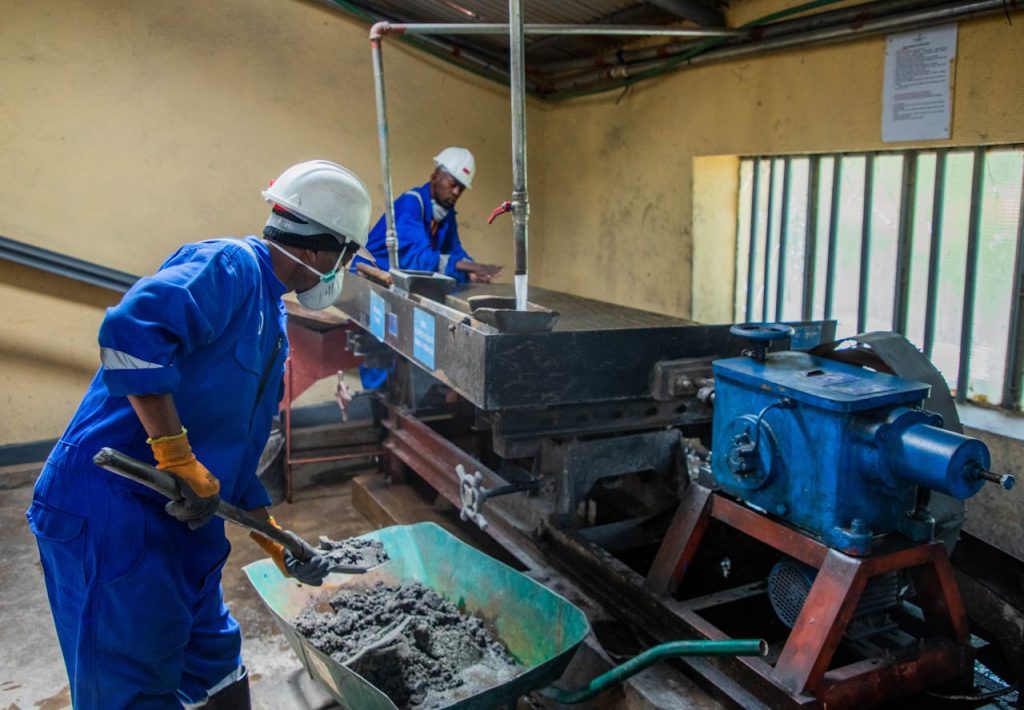
In December 2025, the Guinean government officially launched construction of the Winning Consortium Alumina Guinea (WCAG) refinery in Dobali, Boké prefecture. With an annual production capacity of 1.2 million tonnes of alumina and capital investment exceeding $1.2 billion, this project is among the largest industrial undertakings ever attempted in Guinea.
The refinery is being developed in partnership with the Winning Consortium — the same Sino-Singaporean group that has been one of Guinea’s largest bauxite exporters and is explicitly designed to process bauxite domestically before shipment rather than shipping raw ore. According to reporting from Mining Weekly, the project is a cornerstone of Guinea’s strategy to integrate more fully into the global aluminum value chain, and its launch ceremony was attended by senior government officials, diplomatic corps members, and industrial partners.
SPIC Refinery: 1.2 Million Tonnes, 250 MW Power Plant
China’s State Power Investment Corporation (SPIC) is simultaneously building another 1.2 million tonne per year alumina refinery in Guinea, with a dedicated 250 MW power plant to support operations. According to Mysteel’s analysis of Guinea’s mineral sector outlook, the SPIC refinery is currently under construction with completion expected by late 2027. This project is supported by the regulatory clarity that Guinea’s government has explicitly extended to in-country alumina refining, making it one of the clearest signals yet of official commitment to the domestic processing agenda.
GAC–Chalco Refinery: $1 Billion, 2 Million Tonne Capacity
In May 2026, Chalco the state-owned Aluminum Corporation of China — publicly announced a $1 billion refinery investment in Guinea, with a confirmed annual capacity of 1.2 million tonnes and an ultimate target capacity of 2 million tonnes. The project marks Chalco’s first offshore refinery anywhere in the world, a distinction that underscores how much confidence the company has built through its decade-long operation of the Boffa bauxite mine in Guinea.
The project is structured as a joint venture between Guinea Alumina Corporation (GAC) and Chalco/Chinalco, with Emirates Global Aluminium also a party. As documented by Discovery Alert’s analysis of the Chalco-Guinea deal, the investment announcement followed approximately two years of structured negotiation, moving from a foundational MOU in early 2024 to a framework agreement in Beijing in June 2024 to a full capital commitment in May 2026.
The project was pending shareholder approval and Guinean government regulatory authorization as of mid-2026, but the scale of preceding commitment over two years of feasibility study and structured negotiation signals high confidence in execution.
Why Guinea’s Bauxite Is Particularly Suited to Refining
Not all bauxite is equally easy to refine. Guinea’s deposits are predominantly gibbsite-dominant, a mineralogical characteristic that requires lower refining temperatures and less energy during the Bayer process the industrial method used to extract alumina from bauxite. This gives Guinea a structural cost advantage in refining compared to deposits in Australia or Brazil, which are often richer in harder-to-process boehmite and diaspore mineral forms.
Boké prefecture’s proximity to Guinea’s existing bauxite mining operations adds to this advantage. Transportation costs for bauxite feedstock typically represent between 15% and 25% of total production costs in alumina refining a burden that is substantially lower when a refinery sits close to the mine rather than relying on long-distance rail or maritime shipment of raw ore.
The Policy Environment Backing the Refining Transition
Guinea’s shift from raw exporter to processor is not aspirational — it is being enforced. The government has implemented export volume caps targeting a reduction from projected 2026 baseline volumes of approximately 183 to 200 million tonnes down to around 150 million tonnes, with the explicit purpose of creating incentives for domestic refining investment rather than raw ore maximization.
Mining companies that hold concessions without delivering on promised refinery commitments face a credible cancellation risk — a lesson drawn from the EGA case. The U.S. Department of State’s 2025 Investment Climate Statement for Guinea confirms that a particular focus of recent reforms has been the enforcement of mining convention obligations, including processing commitments that some companies had previously treated as optional.
Where the Remaining Investment Opportunity Sits
Despite the pace of announced projects, Guinea’s 2030 refinery target of 5–6 facilities with 7 million tonnes of combined capacity is not yet fully subscribed. The pipeline of announced projects covers a meaningful portion of this ambition, but gaps remain — particularly in ancillary industrial services, energy supply, construction materials, equipment maintenance, workforce development, and logistics infrastructure supporting refinery operations.
For investors unable to participate at the refinery equity level, the alumina refining buildout creates equally compelling opportunities across:
- Power and energy infrastructure supporting energy-intensive refinery operations
- Construction materials and civil engineering for ongoing facility buildout
- Logistics and port services handling alumina export flows through Guinea’s expanding terminal network
- Workforce training and technical services for an industrial workforce being built largely from scratch
How Yes! Invest Guinea Supports Alumina and Bauxite Investors
Yes! Invest Guinea connects investors with structured, compliant opportunities across Guinea’s bauxite and alumina refining value chain. Our support includes:
- Identifying equity and service-layer opportunities within the refinery development pipeline
- Facilitating introductions to major operators including WCAG, Chalco/GAC, and SPIC
- Coordinating with the Ministry of Mines and Geology and APIP for concession and permit navigation
- Advising on Investment Code incentives available to processing and industrial investors
- Monitoring the regulatory environment around export caps, processing mandates, and concession compliance requirements
Frequently Asked Questions
- What is Guinea’s goal for alumina refining by 2030? The government is targeting five to six operational alumina refineries with a combined annual capacity of approximately 7 million metric tons, transforming Guinea from a raw bauxite exporter into a significant alumina producer.
- Which alumina refinery projects are currently under construction in Guinea? Three major projects are actively progressing: the $1.2 billion WCAG refinery in Boké (under construction since December 2025), the SPIC refinery with a dedicated 250 MW power plant (completion expected late 2027), and the Chalco/GAC joint venture announced in May 2026 with a $1 billion commitment.
- Why is Guinea’s bauxite particularly well-suited for domestic alumina refining? Guinea’s bauxite is predominantly gibbsite-dominant, requiring lower processing temperatures than harder mineralogical forms, giving local refineries a structural energy cost advantage. Refinery proximity to mining areas also reduces feedstock transportation costs significantly.
- What happens to companies that hold Guinea bauxite concessions but fail to build promised refineries? The government has demonstrated willingness to cancel concessions for companies that do not deliver on processing commitments, as shown by the revocation of an EGA subsidiary’s concession in 2025.
- How can Yes! Invest Guinea help investors access Guinea’s alumina refining sector? Yes! Invest Guinea identifies equity and service-layer entry points, facilitates introductions to major project operators, and coordinates with government agencies and APIP for permit and Investment Code access.
Position Yourself in Guinea’s Alumina Refining Transformation
Guinea’s shift from raw bauxite exporter to alumina refining hub is underway with over $3 billion in refinery investment already committed and a government actively enforcing processing mandates. The window to enter at a favorable stage is open now.
Connect with Yes! Invest Guinea today to explore bauxite and alumina refining investment opportunities tailored to your strategy.