Logistics and infrastructure services in Guinea are undergoing the most significant transformation in the country’s post-independence history. A 650-kilometer trans-Guinean railway now carries iron ore from the Simandou mines in the southeast to the new Forécariah port on the Atlantic coast. Four new locomotives bearing Guinean names are already operational on the TransGuinean corridor. The Compagnie du TransGuinéen (CTG), the joint venture managing this infrastructure corridor, has begun commissioning what will become one of Africa’s most significant freight rail systems, capable of transporting up to 120 million tonnes of iron ore annually once fully ramped up.
This is not a future story. It is happening now, and it is reshaping the commercial logic of every investment in Guinea. For investors across mining, agriculture, commercial real estate, manufacturing, and trade, understanding Guinea’s logistics and infrastructure landscape is not optional background knowledge. It is the foundation on which every viable business case in the country must be built.
Guinea’s Infrastructure Transformation: The Simandou 2040 Backbone
The Trans-Guinean Railway: Africa’s Most Consequential New Infrastructure
The TransGuinean corridor is managed by the Compagnie du TransGuinéen (CTG), a joint venture between the Guinean State holding a 15 percent equity stake, Rio Tinto’s SimFer consortium, and the Winning Consortium Simandou (WCS). The first iron ore vessel departed the Forécariah port on December 3, 2025, marking the operational commencement of what the International Monetary Fund projects could expand Guinea’s GDP by approximately 26 percent by 2030.
The 650-kilometer railway is not a single-use mining asset. It is designed from the outset as a multi-use corridor capable of transporting agricultural products, general freight, and eventually passengers. The Compagnie du TransGuinéen expects to deliver the first passenger and freight stations by end-2026, and the corridor directly shortens transit distances for landlocked neighbors including Mali, positioning Guinea as a potential regional transit hub with an alternative to the ports of Dakar and Abidjan.
For investors, the railway’s multi-use mandate means that businesses in agribusiness, food processing, consumer goods distribution, and general manufacturing along the corridor route gain access to logistics connectivity that simply did not exist before 2025. The interior regions of Guinea, previously isolated from international export markets by road infrastructure limitations, now have a direct link to a deep-water port capable of handling Panamax-scale bulk carriers.
Port Expansion and Conakry’s Growing Export Capacity
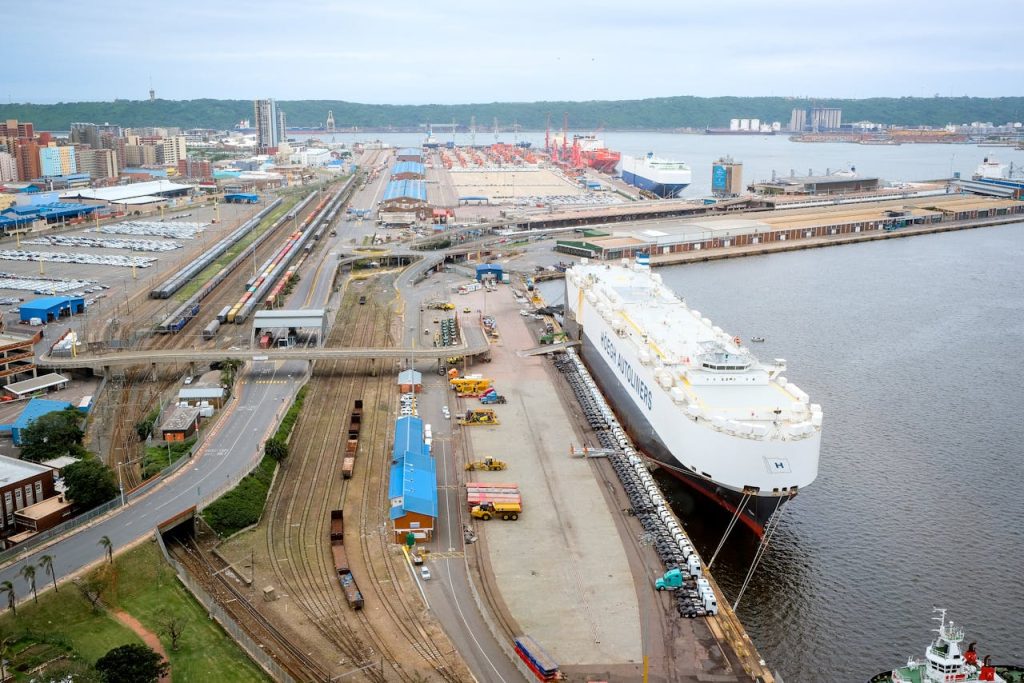
Conakry’s port infrastructure has expanded significantly alongside the mining sector’s growth. Guinea nearly doubled its bauxite export port capacity in 2025, growing from five to nine operational export facilities. The Morebaya deep-water port, connected to the Simandou corridor, adds dedicated mineral export capacity that reduces congestion pressure on Conakry’s general cargo terminals and improves turnaround times for non-mining commercial shipments.
For commercial investors, port expansion means improved import logistics for consumer goods, construction materials, industrial inputs, and equipment. Guinea remains an import-dependent economy for a wide range of manufactured goods, and improving port efficiency directly reduces the landed cost of imported inventory for businesses operating across every sector. According to the African Development Bank’s infrastructure investment analysis, every dollar invested in African transport infrastructure generates up to USD 1.50 in economic output, reflecting the sector’s foundational role in unlocking broader economic productivity.
The Simandou 2040 Program: USD 200 Billion Over 15 Years
Guinea’s government launched the Simandou 2040 program in October 2025, a comprehensive national development strategy structured around the Simandou project’s railway and port infrastructure. The program encompasses a total investment commitment of USD 200 billion over fifteen years, with USD 65 billion targeted between 2025 and 2030. Private sector participation is expected to contribute 70 percent of total investment, creating one of the largest private infrastructure investment pipelines in West African history.
The Simandou 2040 program spans 122 strategic projects and 36 structural reforms across 14 priority sectors, with infrastructure, energy, and transport as a core pillar. Specific programs include upgrades to national road networks connecting the corridor to secondary cities, development of hydroelectric and solar energy facilities to power industrial zones and logistics hubs, and the development of new economic zones along the railway route where the corridor creates new commercial gravity points.
The Logistics Gap That Investors Must Plan Around
Road Infrastructure: Improving Along Key Corridors, Still Challenging Elsewhere
Guinea’s road network connects Conakry to key interior cities including Kindia, Mamou, Labé, and Kankan along primary corridors that are generally navigable by heavy freight vehicles. However, secondary and tertiary roads in rural areas and forest regions remain poorly maintained, and logistics costs for operations in interior prefectures are significantly higher than coastal averages.
The Simandou 2040 program’s infrastructure pillar includes national road network upgrades, and the new railway corridor itself improves connectivity along a major interior axis. But investors establishing operations outside Conakry and its immediate hinterland must budget for logistics costs, vehicle maintenance requirements, and supply chain lead times that reflect the current state of the road network rather than its projected future condition.
Power and Energy Infrastructure
Reliable electricity supply is one of the most consistent operational challenges for businesses in Guinea. Grid power is unreliable in Conakry and largely absent from most secondary cities, meaning that any commercial or industrial operation requiring consistent electricity must invest in dedicated generation capacity from project inception. This is not an insurmountable challenge, and it is a known cost that sophisticated investors build into their financial models.
The good news is that Guinea’s energy infrastructure is improving structurally. The Souapiti hydroelectric dam began producing electricity in 2021. The Amaria dam, financed in part by Chinese mining firm TBEA, is expected to commission by 2026 with 300 megawatts of capacity. Alumina refinery projects in the Boké and Boffa corridors are contracting dedicated power supply through the SPIC-Boffa development’s 250-megawatt integrated power plant. As the energy infrastructure scales with industrial demand, the power constraints that characterize Guinea today will progressively ease over the 2026 to 2030 period.
Cold Chain and Temperature-Controlled Logistics
Guinea’s cold chain infrastructure is among the most acutely underdeveloped logistics categories in the country. Cold storage capacity at Conakry port, at fish landing sites, and at agricultural processing facilities is negligible relative to the commercial demand for temperature-controlled storage from food distribution, pharmaceutical supply chains, seafood export, and dairy and poultry processing. Investors who establish ice production plants, refrigerated transport fleets, or cold storage facilities are entering a market with zero meaningful competition and a captive, growing demand from every sector that handles perishable goods.
Investment Opportunities in Guinea’s Logistics and Infrastructure Sector
Freight Logistics and Third-Party Warehousing
With less than 100,000 square meters of formal warehouse space serving a USD 20 billion economy, the case for third-party logistics (3PL) investment in Guinea is as direct as any investment thesis in the country. Professional freight forwarding, customs clearance services, bonded warehousing, and last-mile distribution platforms all serve a captive market with no formal competition and a growing commercial tenant base from mining, retail, and manufacturing sectors.
Road Freight and Intermodal Transport
As the TransGuinean railway ramp-up drives increasing freight volumes through interior corridors, the need for reliable road-to-rail and road-to-port intermodal transport services grows proportionally. Truck fleet operators, freight forwarding companies, and equipment rental businesses that position themselves along the Simandou corridor route will serve a guaranteed and growing demand stream from mining and industrial operators who have no alternative domestic logistics provider.
Construction Materials Supply Chain
Guinea’s USD 65 billion infrastructure investment pipeline between 2025 and 2030 generates demand for construction materials, equipment, and services that the domestic supply chain cannot meet from existing capacity. A 2025 cement shortage that disrupted construction projects across the country illustrated the fragility of Guinea’s construction supply chain and the commercial value of established local supply infrastructure. Investors in construction materials importation, storage, and distribution are entering a market where demand is contracted and growing.
Digital and Technology-Enabled Logistics
GPS fleet tracking, transport management systems, electronic cargo documentation, and customs clearance software are all underdeveloped in Guinea relative to the logistics needs of the mining, agribusiness, and commercial sectors. Technology-enabled logistics services that improve visibility, efficiency, and compliance across Guinea’s freight supply chains are investment opportunities with low capital requirements, high scalability, and strong alignment with the digital economy priorities embedded in the Simandou 2040 program.
For investors assessing logistics and infrastructure opportunities across all of these categories, YES! Invest in Guinea provides specialist facilitation covering regulatory approvals, land access, Investment Code applications, and connections with established logistics operators and government counterparts responsible for the Simandou 2040 infrastructure program.
FAQ: Logistics and Infrastructure Investment in Guinea
- What is the TransGuinean corridor and why does it matter for non-mining investors? The TransGuinean corridor is a 650-kilometer railway linking Simandou’s iron ore mines to the Forécariah port, commissioned in late 2025. It is designed as a multi-use freight and passenger corridor, which means businesses in agribusiness, food processing, consumer goods, and manufacturing along its route gain logistics access to a deep-water port for the first time. The corridor also positions Guinea as a potential transit hub for landlocked Mali, opening regional trade opportunities for logistics service providers.
- How much is Guinea investing in infrastructure between 2025 and 2030? Guinea’s Simandou 2040 program targets USD 65 billion in total investment between 2025 and 2030, with USD 200 billion planned over the full fifteen-year program. Seventy percent of this investment is expected to come from the private sector, creating one of the largest private infrastructure investment pipelines in West African history across railway, port, energy, road, and industrial zone development.
- What are the biggest logistics challenges investors will face operating in Guinea today? The three primary logistics challenges are unreliable grid electricity, requiring dedicated power generation investment; variable road quality outside primary corridors, requiring higher budgets for vehicle maintenance and logistics costs in interior locations; and the near-total absence of formal cold chain infrastructure, which is both a challenge and a direct investment opportunity for investors in food, pharmaceutical, and seafood sectors.
- Is Guinea’s port infrastructure adequate to support commercial import operations? Guinea’s port capacity has expanded significantly, with bauxite export facilities growing from five to nine operational ports by 2025. Conakry’s general cargo port handles commercial imports for the broader economy. The Morebaya deep-water port adds dedicated mineral export capacity. While port congestion and handling efficiency remain areas for improvement, the expansion trajectory is positive, and logistics service providers operating at port can capture growing volumes as both mining exports and commercial imports increase.
- How does YES! Invest in Guinea support logistics and infrastructure investors? YES! Invest in Guinea provides end-to-end facilitation for logistics and infrastructure investors, covering Investment Code applications for qualifying logistics development projects, land access and warehouse site identification, regulatory approvals for transport and freight service businesses, connections with the Simandou 2040 program’s Delivery Unit for infrastructure pipeline opportunities, and government liaison with the Ministry of Transport and related infrastructure agencies throughout the investment lifecycle.
Position Your Business on Guinea’s Infrastructure Growth Curve
Guinea’s logistics and infrastructure landscape is transforming at a pace that the investment community is only beginning to register. The TransGuinean railway is operational. Port capacity is expanding. The Simandou 2040 program is deploying USD 65 billion by 2030. The investors who establish logistics and infrastructure positions now are building assets whose value grows in direct proportion to the industrial and commercial activity that Guinea’s infrastructure investment is designed to unlock.
YES! Invest in Guinea is your specialist gateway to Guinea’s logistics and infrastructure investment opportunity. From warehousing and cold chain to transport services and construction materials supply, our team provides the regulatory expertise, government relationships, and market intelligence that translate Guinea’s infrastructure transformation into your most strategically positioned business investment.
Explore logistics and infrastructure investment opportunities in Guinea →
Ready to assess your specific logistics investment opportunity? Contact our advisors today for a confidential consultation and let us map your Guinea infrastructure strategy together.