Guinea is moving. The Simandou iron ore project, the Boké bauxite corridor, five alumina refineries under development, and a USD 22 billion economy growing at 5.7 percent annually are generating an industrial momentum that the country’s physical infrastructure has not yet caught up with. At the center of this gap sits one of the most straightforward commercial opportunities in Guinea’s entire investment landscape: industrial parks and warehousing.
Guinea currently has less than 100,000 square meters of formal warehouse space serving a USD 20 billion, import-dependent economy. In comparable markets at a similar stage of development, that figure would be five to ten times larger. For investors who understand what industrial infrastructure supply gaps mean in a growing economy, this number is not a problem. It is an entry point.
The State of Guinea’s Industrial Infrastructure
A Recognized Gap With Government-Mandated Solutions
Guinea’s government formally recognized the industrial land and infrastructure deficit years ago. In 2017, a presidential decree created a Special Economic Zone (SEZ) in the Boké corridor of western Guinea, the heart of the country’s bauxite mining belt, though full development of this zone is still progressing. More broadly, the government established AGESPI, the Agency for the Promotion and Management of Industrial Parks, as the institution responsible for implementing national policy on industrial zone development and management.
AGESPI oversees a total of 944 hectares of designated industrial land across eight development zones, all located in and around the Conakry region. The State has subdivided this land into industrial lots and provided basic access road infrastructure, creating a foundation that private developers can build upon to deliver the utilities, warehousing, and facilities services that industrial tenants require. This public-private partnership framework makes Guinea’s industrial park sector one of the most clearly defined investment models in the country, with government-designated land, an established institutional counterpart, and a growing pipeline of industrial tenants who need space.
The Warehousing Deficit in Real Numbers
The warehousing supply-demand gap in Guinea can be measured in concrete terms. According to market analysis published on YES! Invest Guinea’s commercial real estate sector overview, Guinea has less than 100,000 square meters of formal warehouse space for an economy worth over USD 20 billion. First-quality warehouse and industrial assets command rental premiums of 40 to 60 percent above the general market average, and tenant retention rates are exceptionally high due to the near-absence of alternatives. Pioneer developers in this space benefit from a combination of strong recurring rental income, minimal competition, and a captive tenant base that has no alternative but to renew.
These dynamics mirror the early industrial real estate markets in countries like Côte d’Ivoire and Senegal a decade ago, where first-mover industrial park developers captured premium returns that later compressed as supply caught up with demand. Guinea is at the beginning of that curve.
Why Industrial Demand Is Accelerating Now
Mining, Refining, and the Supply Chain It Creates
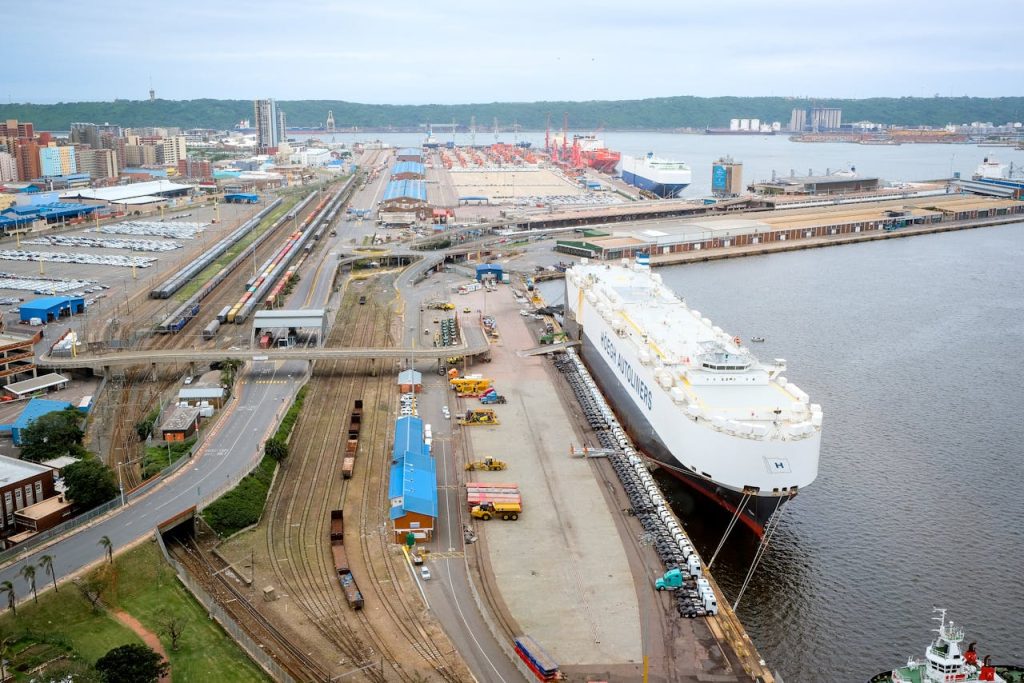
The scale of Guinea’s industrial activity is growing rapidly and pulling supply chain infrastructure demand with it. The Simandou iron ore project alone involves 650 kilometers of Trans-Guinean Railway connecting mine sites to the port of Conakry, which is simultaneously being expanded to handle higher cargo volumes. Five alumina refinery projects are in various stages of development in the Boké and Boffa regions, each requiring dedicated logistics corridors, storage facilities, and maintenance infrastructure.
Every major industrial operation creates downstream demand for warehousing and logistics services: storage of consumables and spare parts, staging areas for equipment maintenance, bonded warehouses for imported inputs, and distribution hubs for finished products. Mining companies, construction contractors, and refinery operators all require professional industrial space to operate efficiently. In Guinea today, that space is almost entirely absent from the formal market.
The AfCFTA Regional Trade Multiplier
Guinea’s membership in the African Continental Free Trade Area (AfCFTA) is a structural demand driver for logistics and warehousing that extends beyond Guinea’s domestic economy. AfCFTA aims to create a single market across 54 African Union member states with a combined GDP of over USD 3.4 trillion, and Guinea’s geographic position as a coastal gateway to landlocked Mali, Guinea-Bissau, and parts of Sierra Leone positions it as a natural regional distribution hub.
As intra-African trade volumes grow under AfCFTA and Guinea’s port capacity expands, the commercial case for Guinea-based regional distribution centers, bonded warehouses, and transshipment facilities strengthens progressively. Investors who develop industrial logistics infrastructure in Guinea today are building assets whose value appreciation is linked not just to Guinea’s domestic economy but to the entire West African regional trade corridor.
Investment Models in Guinea’s Industrial Parks and Warehousing Sector
Industrial Park Development on AGESPI-Designated Land
The most direct investment model involves partnering with AGESPI to develop one or more of Guinea’s eight designated industrial zones. This model typically involves:
- Land lease agreement: Securing a long-term industrial land concession from AGESPI on designated lots within an established zone.
- Infrastructure development: Installing utilities including electricity, water, drainage, and telecommunications to the industrial standard required by target tenants.
- Built-to-suit facilities: Constructing warehouses, light manufacturing units, workshop spaces, and shared service infrastructure to tenant specifications under long-term lease agreements.
- Park management services: Operating the park as an ongoing business, providing security, maintenance, energy management, and tenant services under a structured fee model.
This model generates revenue from land leases, facility rentals, and service charges across a diversified tenant base, with anchor tenants typically from the mining, construction, agribusiness, and logistics sectors.
Standalone Warehousing and Cold Storage
Simpler in structure and faster to execute, standalone warehousing development targets the specific storage and distribution needs of Guinea’s commercial and industrial sectors. High-priority opportunities include:
- Dry goods warehousing: General cargo storage for Guinea’s large import trade in consumer goods, construction materials, and industrial inputs.
- Cold chain and temperature-controlled storage: Serving food distribution, pharmaceutical supply chains, and seafood processing and export operations. Cold storage is among the most acutely undersupplied categories of commercial real estate in Conakry.
- Bonded warehousing: Operating under customs authority to enable duty-free storage of imported goods pending re-export or staged domestic distribution.
- Mining supply depots: Dedicated storage and distribution facilities located near mining clusters in Boké, Boffa, and Simandou serving equipment, consumables, and spare parts logistics for mining operators.
Logistics Hub Development
Combining warehousing with freight forwarding, customs clearing, and last-mile distribution services creates an integrated logistics hub model that captures multiple revenue streams from a single facility investment. Guinea’s limited formal logistics infrastructure means that integrated facilities offering end-to-end storage and distribution services command significant premium pricing from both domestic distributors and international companies seeking to establish efficient Guinea supply chains.
The African Development Bank identifies logistics hub development as a critical investment category for West African economic growth, with the region’s infrastructure deficit costing an estimated 2 to 3 percentage points of GDP annually through inefficiency and excess transport costs.
Regulatory Framework and Investment Incentives
Guinea’s industrial park and warehousing sector operates within a framework administered by AGESPI under the Ministry of Industry, SMEs, and Private Sector Promotion. Key regulatory and incentive elements include:
- Investment Code incentives: Industrial park investors qualify for Guinea’s Investment Code provisions, including tax holidays of up to 8 years and customs duty exemptions on imported construction materials and equipment for qualifying industrial zone development projects.
- SEZ framework: The 2017 presidential decree establishing the Boké SEZ provides additional incentives for investors in the corridor, including streamlined customs processing and import-export facilitation for SEZ-based operations.
- Land tenure: Industrial lots within AGESPI-designated zones are available under long-term concession agreements, providing investors with defined land rights for the duration of their development and operation.
- Local content compliance: Guinea’s Local Content Law requires significant local employment and use of local suppliers, which industrial park operators must incorporate into tenant agreements and park management practices.
For investors navigating AGESPI relationships, SEZ applications, and Investment Code approval processes, YES! Invest in Guinea provides specialist facilitation covering land access, regulatory approvals, ministry engagement, and tenant identification across Guinea’s industrial and logistics sectors.
FAQ: Industrial Parks and Warehousing Investment in Guinea
- How much formal warehouse space does Guinea currently have and what does that mean for investors? Guinea has less than 100,000 square meters of formal warehouse space despite being a USD 20 billion economy. This severe undersupply means first-quality industrial assets command rental premiums of 40 to 60 percent above the general market, tenant retention is extremely high due to the absence of alternatives, and pioneer developers face minimal competition while serving a captive and growing tenant base from the mining, construction, logistics, and consumer goods sectors.
- What is AGESPI and how does it support industrial park investors in Guinea? AGESPI is Guinea’s Agency for the Promotion and Management of Industrial Parks, operating under the Ministry of Industry. It administers 944 hectares of designated industrial land across eight zones in the Conakry region, offers industrial lots on long-term concession, and serves as the government’s institutional partner for private developers building out Guinea’s industrial park infrastructure. Engaging AGESPI is the formal entry point for industrial zone development in Guinea.
- What types of industrial tenants are most active in Guinea’s market right now? The most active industrial tenants in Guinea are mining companies and their contractors, construction and civil works firms, logistics and freight forwarding operators, consumer goods distributors, and agribusiness and food processing companies. The expansion of Guinea’s alumina refinery pipeline and the Simandou iron ore project are generating particularly strong demand for industrial space near port and logistics corridors.
- Are there specific zones designated for industrial development near Guinea’s mining corridor? Yes. A special economic zone was established in the Boké corridor by presidential decree in 2017, targeting the mining and processing belt of western Guinea. Additionally, the Trans-Guinean Railway corridor connecting Simandou to Conakry port creates a logistics spine along which industrial and warehousing facilities are particularly well-positioned to serve both mining sector demand and general freight distribution.
- What incentives are available for industrial park and warehousing investors under Guinea’s Investment Code? Guinea’s Investment Code provides tax holidays of up to 8 years and customs duty exemptions on imported construction materials and equipment for qualifying industrial development projects. SEZ-based investors receive additional incentives including streamlined customs processing and import-export facilitation. The size and duration of incentives are determined by investment amount, employment generation, and location within priority zones.
Develop Guinea’s Industrial Future With a First-Mover Advantage
Guinea’s industrial infrastructure gap is not closing by itself. The mining boom is accelerating demand faster than informal supply can meet it, and the window to establish premium industrial assets in a market with no meaningful competition is available right now, not indefinitely.
YES! Invest in Guinea is your specialist gateway to Guinea’s industrial park and warehousing sector. From AGESPI land access and Investment Code approvals to tenant identification and industrial zone management, our team provides the regulatory expertise and institutional connections that transform Guinea’s infrastructure gap into your most profitable development opportunity.
Explore industrial parks and warehousing investment opportunities in Guinea →
Ready to discuss your specific development vision? Contact our investment advisors today for a confidential consultation and let us map your industrial investment strategy together.