Food and beverage manufacturing in Guinea is one of the most commercially logical investments in West Africa. The country has 6.2 million hectares of arable land, less than 25 percent of which is currently cultivated. It is the world’s largest producer of fonio, a high-value superfood with growing global demand. It produces pineapples, mangoes, palm oil, cashews, groundnuts, cocoa, and coffee across diverse agroclimatic zones. And despite all of this agricultural wealth, Guinea imports a substantial proportion of its processed food, packaged beverages, edible oils, and consumer staples from Asia, Europe, and neighboring African countries.
This is not a resource problem. Guinea’s raw material base is exceptional. It is a manufacturing gap, and for investors who understand what that means in a market of 16 million people growing at 5.7 percent annually, it is a gap worth filling.
Guinea’s Food and Beverage Market: The Numbers Behind the Opportunity
Import Dependency as a Commercial Signal
Guinea’s processed food market is predominantly served by imports. Consumer goods including packaged rice, edible cooking oils, biscuits, confectionery, canned goods, bottled water, soft drinks, and packaged dairy products are largely imported from Asia, Europe, and other West African nations. This import dependency is not a reflection of weak consumer demand. It reflects the near-total absence of formal domestic food processing and manufacturing capacity that can supply urban consumers at competitive price points.
The World Bank’s Guinea Commercial Agriculture Development Project identifies Guinea’s agricultural value chains as significantly underutilized, noting that only 25 percent of cultivable land is used and less than 10 percent is cropped annually. The potential for food manufacturing to capture value from Guinea’s existing agricultural base, converting raw materials into processed consumer goods for the domestic and regional market, is among the most straightforward investment propositions in the country’s entire economy.
A Growing Urban Middle Class Driving Packaged Goods Demand
Conakry’s urban population is growing rapidly, and urbanization consistently drives the transition from subsistence consumption patterns toward packaged, branded, and convenience food products. Mining sector expansion, the influx of expatriate workers, diplomats, NGO staff, and business travelers, and the growth of Guinea’s urban professional class are all creating consumer segments with purchasing power and preferences that domestic production has not yet organized to serve.
Franprix’s entry into Guinea in 2026 with supermarket operations in Conakry’s Coleah and Kipé districts reflects an institutional assessment that Guinea’s urban consumer market has reached the threshold of viability for organized retail. Where modern supermarket retail operates, demand for locally manufactured consumer food products follows, because locally produced goods can compete on freshness, price, and shelf life against imported equivalents in ways that are difficult to achieve from distance.
The Mining Corridor as a Captive Consumer Market
One of the most underappreciated drivers of food and beverage demand in Guinea is the concentrated industrial workforce created by the bauxite and iron ore mining clusters. The Boké bauxite corridor and the Simandou iron ore project together employ tens of thousands of workers at mine sites, construction camps, port facilities, and associated service operations. These workers represent a captive, high-volume, predictable demand base for packaged food, bottled water, beverages, and catering supply. Mining companies operating at this scale consistently contract food supply through organized channels rather than spot markets, making mining workforce catering a structured B2B revenue stream for food manufacturers who can supply reliably at volume.
The Raw Material Advantage: Guinea’s Agricultural Foundation for Manufacturing
Fonio: The Global Superfood That Guinea Leads
Guinea is the world’s largest producer of fonio, an ancient West African cereal grain that has attracted significant international attention as a gluten-free, high-protein superfood with exceptional nutritional profiles. Fonio cultivation is embedded in Guinean agricultural tradition across the Fouta Djallon highlands, and the grain has strong export market potential in Europe, North America, and Asia where demand for specialty grains and health foods is growing rapidly.
The World Bank’s Commercial Agriculture Development Program for Guinea specifically identifies fonio as a priority value chain for private investment, citing Guinea’s position as the top global producer and leading exporter in the region, and the crop’s important prospects in international markets as a superfood. Establishing fonio cleaning, processing, packaging, and export operations in Guinea captures a premium export price point that no competitor country can match, because none produces fonio at Guinea’s scale or quality.
Tropical Fruits: Pineapple, Mango, and Palm Oil
Guinea’s tropical climate and diverse geography support production of pineapples, mangoes, and palm oil in quantities that far exceed current formal market absorption. These commodities are attracting increasing private investor interest, with their production and export prospects specifically identified as value chains with immediate commercial viability by the World Bank’s agricultural development framework for Guinea.
Pineapple processing for juice, concentrate, and dried fruit products offers export margins that fresh fruit trading cannot achieve. Mango processing into purees, dried fruit, and juice provides shelf-stable products that overcome the seasonal production constraints limiting fresh mango markets. Palm oil refining and fractionation converts crude palm oil into refined cooking oil, margarine, and oleochemical feedstocks for domestic consumer goods and regional export markets. Each of these processing models converts Guinea’s raw agricultural surplus into higher-value manufactured products that command better pricing, longer shelf life, and broader market reach.
Cassava, Groundnuts, and Staple Crop Processing
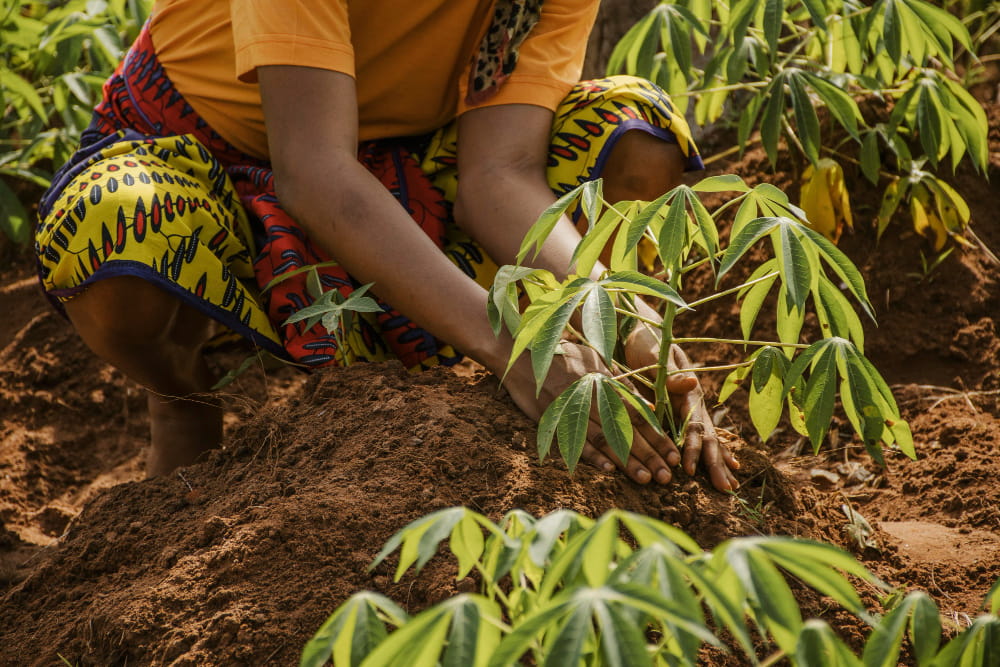
Cassava is a staple food crop produced widely across Guinea’s agricultural regions. Converting cassava into gari (fermented, dried cassava), starch, flour, and cassava-based snack products creates domestic food manufacturing capacity that serves both urban retail markets and institutional catering demand. Groundnut processing into cooking oil, peanut paste, and packaged snack products similarly converts a widely grown domestic crop into manufactured consumer goods with predictable demand across all income levels.
Investment Models in Guinea’s Food and Beverage Manufacturing Sector
Packaged Water and Soft Drinks
The beverages sector in Guinea is one of the most established segments of the domestic food and beverage industry. SOBRAGUI, a subsidiary of the Castel BGI Group since 2008, operates two industrial facilities in Conakry and Kissidougou, producing beer, soft drinks, and energy beverages for the Guinean market across brands including Beaufort Lager, 33 Export, Guiluxe, and Skol. SOBRAGUI’s operation demonstrates that beverage manufacturing in Guinea is commercially viable at industrial scale.
The packaged water market represents an adjacent opportunity that is currently underdeveloped relative to demand. Clean, affordable packaged drinking water is one of the most consistent consumer needs in Guinea’s urban and peri-urban markets, and a locally produced bottled or sachet water brand serving Conakry’s growing population addresses both a public health need and a commercial demand that imported alternatives cannot serve cost-effectively.
Edible Oil Refining and Consumer Cooking Oils
Guinea imports the majority of its edible cooking oils, yet produces palm fruit and groundnuts domestically at significant volume. Establishing an edible oil refinery that processes domestically grown palm fruit or imports crude palm oil for refining into branded consumer cooking oil products captures import substitution margins while creating local employment in processing, packaging, and distribution. The 70 percent soap and detergent import rate across Africa, documented by sector analysts, reflects the same opportunity: where raw materials exist, replacing imports with locally manufactured goods creates structurally sound manufacturing businesses.
Packaged and Processed Staple Foods
Rice milling, fonio processing, cassava flour production, and packaged groundnut products all represent entry-level food manufacturing investments with modest capital requirements and immediate access to domestic markets. These products serve Guinea’s mass-market consumer base at price points accessible across income levels and create the foundation for brand building in Guinea’s evolving modern retail environment.
Premium and Export-Oriented Food Products
For investors targeting international markets alongside the domestic opportunity, Guinea’s fonio, tropical fruit products, and specialty agricultural outputs offer premium export pricing in European health food, organic, and specialty grocery channels. The Food and Agriculture Organization (FAO) identifies West African specialty crops including fonio as having significant untapped export value in global health food markets. Guinea’s proximity to European markets gives it a logistical competitive advantage over Asian producers in supplying European specialty food retailers.
Catering and Institutional Food Supply
Mining camps, construction sites, hospital facilities, schools, and government offices across Guinea represent institutional food supply contracts that scale with the Simandou 2040 program’s industrial workforce expansion. An investor establishing a centralized food production and catering supply operation in Conakry with logistics reach to key mining corridors in Boké and the Forest Region can serve mining companies, construction contractors, and NGOs through structured supply agreements that provide predictable, recurring revenue independently of retail market development.
For end-to-end facilitation across all food and beverage manufacturing investment models in Guinea, including regulatory approvals, Investment Code applications, land access, and market connections, YES! Invest in Guinea provides specialist support from initial feasibility through to operational launch.
FAQ: Food and Beverage Manufacturing Investment in Guinea
- What raw materials are available in Guinea for food and beverage manufacturing? Guinea produces fonio (the world’s leading producer), pineapples, mangoes, palm fruit, groundnuts, cassava, rice, cocoa, coffee, and cashews across its diverse agricultural regions. Less than 25 percent of Guinea’s 6.2 million hectares of arable land is cultivated, meaning raw material supply can scale in direct proportion to processing demand. Proximity to European markets provides a logistical advantage for export-oriented processed food products.
- What food and beverage companies are currently operating in Guinea? SOBRAGUI, a Castel BGI Group subsidiary established since 1948, operates the most significant industrial beverage manufacturing in Guinea, with facilities in Conakry and Kissidougou producing beer, soft drinks, and energy beverages. The food processing sector outside beverages remains largely artisanal and informal, with almost no formal packaged food manufacturing, creating a wide-open field for investors entering consumer staple, specialty food, and packaged goods categories.
- What government support exists for food and beverage manufacturing investors in Guinea? Guinea’s Investment Code provides tax holidays and customs duty exemptions on imported manufacturing equipment for qualifying agribusiness investments. The World Bank’s Commercial Agriculture Development Program and IFAD’s AgriConnect Guinea Pact, launched in April 2026, both prioritize food value chain investment with co-financing, technical assistance, and market development support available for private investors aligning their business models with national food security and agricultural development priorities.
- What is the most commercially accessible entry point for food manufacturing in Guinea? Packaged water and soft drinks offer the most immediately accessible entry point, with proven domestic market demand, straightforward manufacturing technology, and no seasonal supply constraints. Edible cooking oil refining and fonio processing are compelling medium-scale entries with strong domestic import substitution demand and, for fonio, significant export market potential. Catering supply to mining and construction sector clients provides a B2B revenue base that does not depend on retail market development.
- How does YES! Invest in Guinea support food and beverage manufacturing investors? YES! Invest in Guinea provides comprehensive facilitation covering Investment Code applications for qualifying food manufacturing projects, Ministry of Industry and Commerce regulatory approvals, food safety certification advisory from the Direction Nationale du Contrôle de Qualité, industrial zone land access and facility site identification, agricultural raw material supply chain development, connections with institutional catering clients in the mining and construction sectors, and government liaison throughout the investment lifecycle.
Manufacture the Food That Guinea’s Economy Is Ready to Buy
Guinea’s consumers are there. The raw materials are growing in the fields. The mining workforce is eating from imported supply chains. The supermarkets are opening. The investment case for food and beverage manufacturing in Guinea is not speculative. It is anchored to documented consumer demand, abundant domestic raw materials, and an institutional market that rewards reliable supply with long-term contracts.
YES! Invest in Guinea is your specialist gateway to Guinea’s food and beverage manufacturing opportunity. From fonio processing and edible oil refining to packaged water and institutional catering, our team provides the regulatory expertise, government relationships, and market connections that convert Guinea’s agricultural abundance into your most productive manufacturing investment.
Explore food and beverage manufacturing investment opportunities in Guinea →
Ready to discuss your specific manufacturing vision? Contact our advisors today for a confidential consultation and let us design your Guinea market entry strategy together.